Currently Empty: $0.00
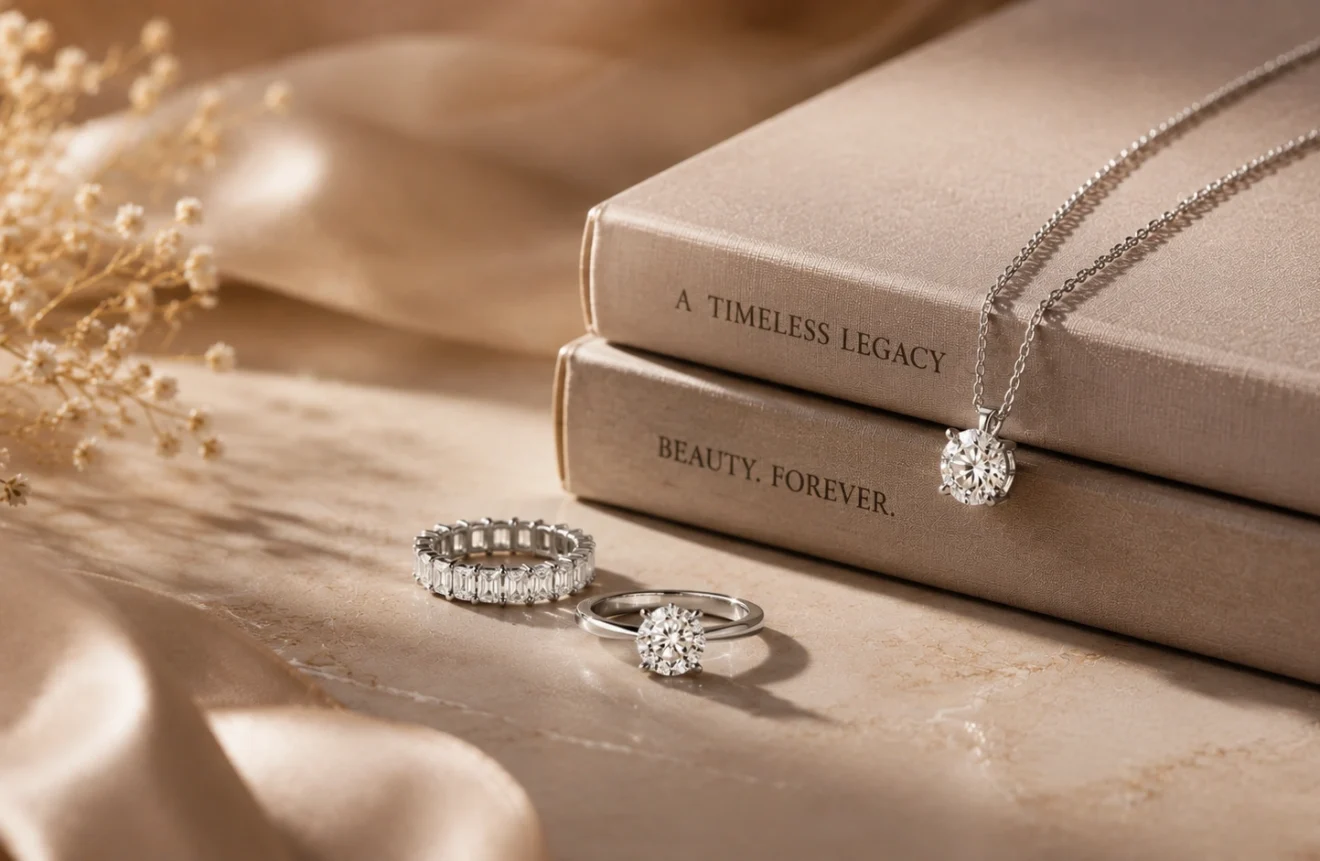
Fashion changes every season. Some jewellery changes with it. Diamonds do not — and that is precisely the point.
Every year, the jewellery industry produces new trends. Chunky gold chains one season, layered delicate pieces the next. Coloured gemstones come in, statement earrings go out, minimalism replaces maximalism, and then maximalism returns. If you buy jewellery to follow fashion, you will spend a lifetime chasing it.
Diamonds sit outside this cycle entirely.
A round brilliant solitaire pendant worn in 1975 looks exactly as relevant today as it did then. A diamond engagement ring from your grandmother’s era does not read as vintage — it reads as classic. This is not an accident. It is the result of qualities unique to diamonds that no other stone, metal, or material can replicate.
This is the story of why diamonds are not just jewellery — they are the only category of jewellery that is genuinely timeless.
What ‘timeless’ actually means
Timeless is an overused word in jewellery marketing. Almost every brand applies it to almost every product. But timelessness has a specific meaning: something that looks equally appropriate across different eras, occasions, ages, and contexts. Very few things actually qualify.
To be truly timeless, a piece of jewellery needs to satisfy three conditions simultaneously:
| It must not date | Styles that feel of their era — the chunky gold of the 1980s, the ultra-thin hoops of the 2000s — carry a timestamp. You can place them in a decade. Diamonds carry no such timestamp. |
| It must work across ages | A piece that suits a 25-year-old but looks wrong on a 55-year-old is not timeless. Diamond studs, solitaire pendants, and simple diamond bands are worn equally beautifully at every stage of life. |
| It must cross occasions | True timeless jewellery moves from casual to formal without a second thought. A diamond solitaire works at a board meeting and a wedding reception with equal ease. |
Gold jewellery satisfies none of these conditions reliably. It dates, it skews cultural or generational, and heavy traditional gold pieces are clearly occasion-specific. A diamond satisfies all three, consistently, across a lifetime.
Gold trends. Diamonds endure.
To understand the difference in longevity, consider how gold jewellery is typically bought and worn versus how diamonds move through time.
| GOLD JEWELLERYHeavily influenced by seasonal trends, regional styles, and cultural moments. What is popular in one decade can feel dated in the next. Making charges mean resale rarely recovers the original cost. Many pieces are melted and remade as tastes shift. | DIAMOND JEWELLERYImmune to trend cycles. The round brilliant cut was perfected in the early twentieth century and has been the world’s most purchased diamond shape every single year since. Certified diamonds hold their grade — and their identity — regardless of when they were cut. |
| The round brilliant diamond has been the most purchased gemstone cut in the world for over a century. Not because marketing keeps it popular — but because its proportions are mathematically optimised to return the maximum light to the human eye. Physics does not go out of style. |
The shapes that never dated
Look at the most iconic jewellery pieces in history — the ones that appear in photographs across decades and still look contemporary. Almost without exception, they are diamond pieces in simple settings.
Audrey Hepburn’s diamond studs. Grace Kelly’s engagement ring. The diamond solitaire pendants worn by women on red carpets from the 1960s through to today. None of these look period. None of them would seem out of place on a woman walking into a restaurant tonight.
Compare this to the gold jewellery of the same eras. The thick rope chains of the 1970s, the wide bangles of the 1980s, the large sculptural gold earrings of the 1990s — all of them immediately place you in a specific decade. They are fascinating as cultural artefacts. They are not timeless.
| Diamond jewellery does not ask when it was made. It only asks to be worn. |
Why this matters for international buyers
For buyers outside India — particularly those living across multiple cultural contexts — the timelessness of diamonds has a very practical dimension.
Gold jewellery that reads as distinctly traditional Indian in design can feel out of place in a Western professional or social context. Many NRI and diaspora buyers find themselves owning beautiful gold pieces they love culturally but rarely wear day-to-day because the pieces feel specific to an occasion or setting.
Diamond jewellery does not have this problem. A diamond pendant or pair of studs from a Bangalore jeweller is indistinguishable in its elegance from one purchased in London or New York. The universal visual language of diamonds means that the piece works in both worlds simultaneously — which is exactly where many of Jiva Diam’s customers live.
This cross-cultural wearability is not a small consideration. It is the difference between jewellery that sits in a box and jewellery that is worn every day.
Certified diamonds: timeless value, not just timeless looks
The timelessness of diamonds extends beyond aesthetics into something more concrete: documented, verifiable value that does not erode with time.
A GIA or IGI certified diamond carries a grade that was determined by an independent laboratory and does not change. The cut, colour, clarity, and carat weight recorded on that certificate are as true today as they will be in fifty years. That means the diamond can be accurately valued, insured, or resold at any point in its life — something no piece of gold jewellery can offer with equivalent precision.
Gold jewellery purchased today may be worth significantly less tomorrow, not because gold prices fell, but because fashion moved on and the making charges that inflated the purchase price cannot be recovered. A certified diamond purchased today retains a verifiable identity indefinitely.
| Gold jewellery has a style life. A certified diamond has no expiry date — in appearance or in value. |
There will always be a place for gold. It is woven into how we celebrate, gift, and mark life’s transitions — and that is not changing. But if you are looking for jewellery that you will still love in twenty years, that your daughter will want to wear, that will look as right at sixty as it does at thirty — a diamond is the only honest answer.
Not because it is more expensive. Because it is the only thing that genuinely does not go out of style.